When it comes to cybersecurity, you may think you’re taking all the necessary steps to protect your critical information by building in safeguards that are an integral part of your IT network.
Rogue hackers, corporate saboteurs and internet vandals pose a clear and present danger to your company — which is why it’s essential to keep the doors to your computer systems locked.
But those same cybersecurity principles should apply to the smartphones — and the accompanying apps — your employees are using, which also contain vital business information.
Your Apps Are Revealing Your Data
A recent investigation by the New York Times illustrated the scale of the issue when it found hundreds of apps can follow your movements and share — read: sell — the details with advertisers, retailers and others.
Rather than someone stealing the information, in this case the people using the apps are giving it away. The Times found at least 75 companies receive anonymous, precise location data from apps whose users enable location services to get local news and weather or other information. Several of those businesses claim they’re tracking as many as 200 million mobile devices in the United States.
That information is worth a lot of money to marketers.
You already know that if you search for a pair of boots online, for instance, those boots will keep popping up on your screen repeatedly. This represents the next generation of consumer-targeted marketing, relying on knowing where you live and work and shop — thanks to information provided by your smartphone. Such location-based marketing represents a $21 billion industry.
Ads Target ER Patients
Here’s a real-world example of why companies want to know where you are. For years, retailers have used GPS-based technology to offer shoppers coupons and other special deals while they shop — because they know you’re in the store, thanks to your smartphone.
Now, law firms and other marketers are using the same kind of geolocation services to send targeted messages to people in specific areas — such as hospital emergency rooms, where the victim of a car accident might be in need of legal services from a personal injury attorney.
“The book ‘1984’ — we’re kind of living it in a lot of ways,” said Bill Kakis, a managing partner at an advertising firm that uses location services to target such ads for its clients.
How to Stop Location Tracking
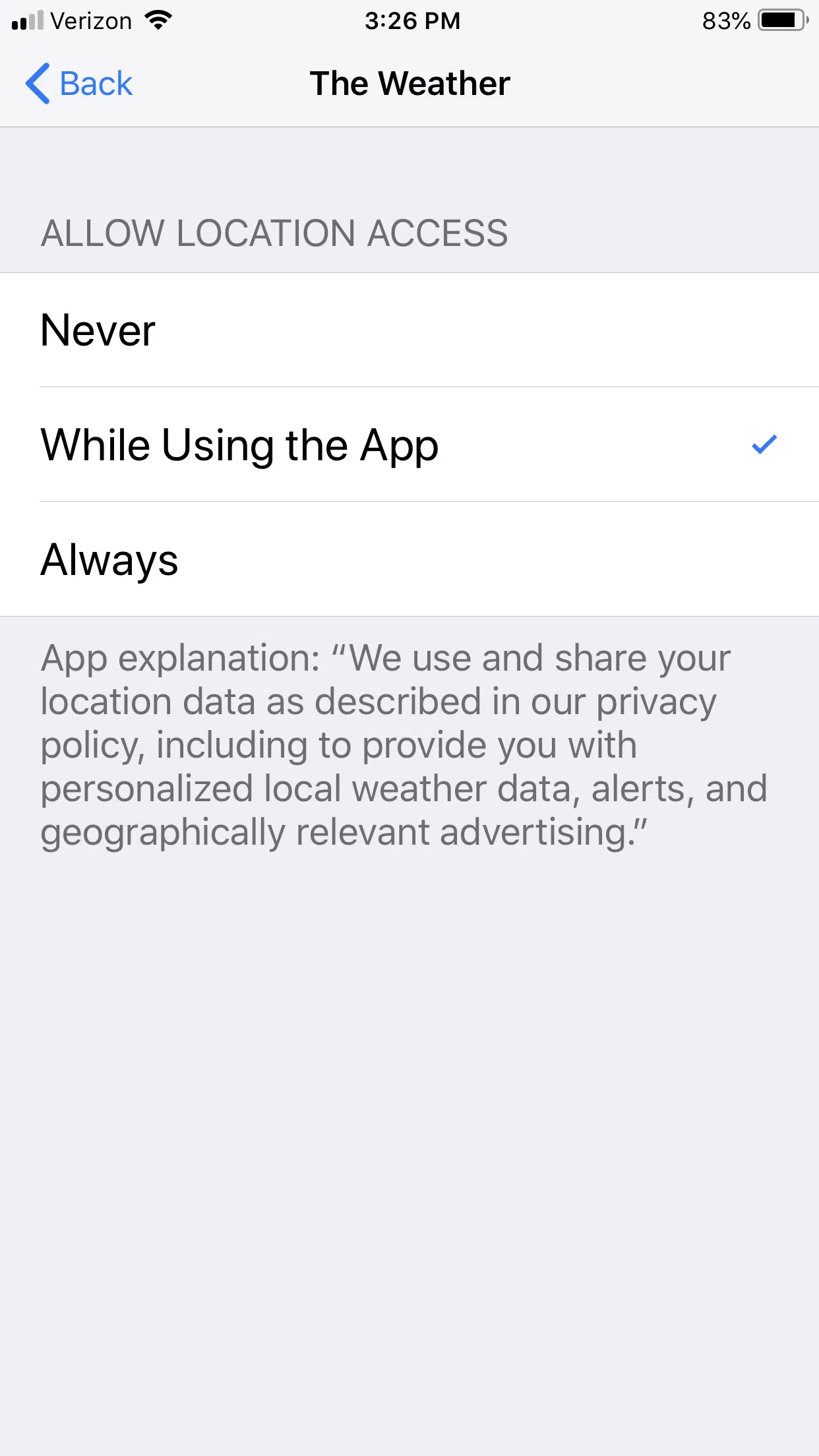 We each determine whether to allow an app to track our location. Each time you set up an app, it gives you an opportunity to customize its permissions.
By limiting those permissions to only the things the app really needs to function — such as knowing your location when using a map or a ride service — you can limit an app’s ability to collect more data than you would want, and potentially use its access in ways you don’t foresee.
Here’s how to do it:
- On Apple, go to Settings and select Privacy. Then select Location Services, which shows a list of all your apps and the location settings for them. You can choose to allow the app to use your location all the time, never or only while you’re using the app.
- On Android, go to Settings and select Security & location. Then select Location. Next, select App level permissions, which shows a list of all your apps and the location settings for them. You can switch them on or off. Unlike Apple’s iPhones, there is no option to use location services only while using the app.
Cultivate a Culture of Security
In today’s business climate, protecting your privacy is paramount — whether you’re using a computer or a smartphone. Years of designing, implementing and managing robust data protection and security have helped us build a team of professionals with in-depth experience in government and industry applications. We’re here to make your IT environment safe and secure so you can conduct your business with confidence.
Call us for a free two-hour consultation, and we’ll talk about your security needs — no strings attached. Our expert engineers can design safeguards that are an integral part of your IT network right from the start. Together, we can develop an IT security plan that meets your needs and fits your budget.
Since 1995, Manassas Park, VA-based V2 Systems has employed local systems administrators, network engineers, security consultants, help desk technicians and partnering companies to meet a wide range of clients’ IT needs, from research, to implementation, to maintenance. Concentrate on your VISION…We’ll handle the TECHNOLOGY!