
Whitepaper: Achieving Regulatory Compliance with a Managed Service Provider for Government Contractors

Jun 22, 2023 | Blog, Cyber Security

If you’re a government contractor working with the Department of Defense (DoD) because you handle Controlled Unclassified Information (CUI) you must adhere to strict federal guidelines stipulated by ITAR, NIST 800-171 or CMMC 2.0. Organizations must not only initially meet regulatory stipulations but continually work to enhance their cybersecurity. DFARS 7012 requires contractors who work with the DoD to follow NIST and also report their SPRS score to the DoD in order to avoid fines and penalties. There’s a lot to consider. Creating a POA&M, meeting the tasks, achieving the milestones set forth. It can all be overwhelming and expensive. Engaging a knowledgeable Managed Service Provider (MSP) can help.
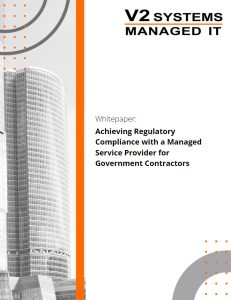
GovCon WhitepaperThis whitepaper is ideal for federal contractors who must achieve, ITAR, NIST and CMMC compliance and are interested in learning how an MSP can provide efficient and cost-effective solutions to maintaining the necessary security standards.

In this whitepaper you will learn:

1. What is NIST, ITAR and CMMC
2. The Role of Managed Service Providers
3. The Advantage of an MSP in Regulatory Compliance
4. How to Select the Right MSP

CLICK HERE TO DOWNLOAD


Since 1995, Manassas Park, VA-based V2 Systems has employed local systems administrators, network engineers, security consultants, help desk technicians and partnering companies to meet a wide range of clients’ IT needs, from research, to implementation, to maintenance. Concentrate on your VISION…We’ll handle the TECHNOLOGY!
More From V2 Systems

The Audit Readiness Problem Government Contractors Can’t Afford to Ignore

Many government contractors are not failing audits because they lack tools. They are failing because documentation is incomplete, evidence is disorganized, and readiness starts too late. This blog explains the most common gaps and how to fix them before an audit begins.

You Can’t Secure What You Can’t See: Why Asset Visibility Is a Cybersecurity Requirement

Asset visibility is one of the most overlooked parts of cybersecurity. In this blog, we explain why businesses need clear visibility into hardware, software, users, and cloud assets to reduce risk, strengthen operations, and support compliance.

When One Suspicious Alert Prevented a Much Bigger Disaster

A former client narrowly avoided a much larger cybersecurity incident after suspicious Microsoft 365 activity revealed an unauthorized intrusion. In this blog, we break down what happened, how phishing may have played a role, why MFA still matters, and what businesses should do next to reduce risk and respond quickly.

CMMC in Practice: How Day-to-Day IT Operations Affect Compliance

CMMC is not just policy. It depends on day-to-day IT execution like patching, access control, monitoring, and documentation. This blog explains what contractors should focus on now, plus why the assessment process can be more expensive than expected.

What Happens After the Breach: How Incident Response Really Works for SMBs

Incident response is what determines whether a cyber incident becomes a short disruption or a major business crisis. This blog explains the real steps SMBs should take after a breach and how MSP support speeds recovery.

Free
Small Business Cybersecurity Checklist

cybersecurity checklist graphic